
Most custom software projects don't fail because of bad code. They fail because nobody clearly defined what needed to be built in the first place. Vague requirements, shifting expectations, and budget overruns almost always trace back to one root cause: poor scoping.
If you've ever handed off a project to a development team only to receive something that missed the mark, you already understand the cost of getting this step wrong. Learning how to scope a custom software project is one of the most valuable skills a business leader can develop, and it's far more strategic than most people realize.
This guide walks you through a proven, practical framework for defining your project with precision before a single line of code is written. You'll learn how to identify real business requirements, align stakeholders, establish boundaries, and create documentation that keeps your entire team accountable. Whether you're preparing for your first custom build or trying to improve outcomes on future initiatives, the steps ahead will give you the clarity and confidence to lead the process effectively.
Why Most Software Projects Run Over Budget Before They Begin
Most software projects do not fail during development. They fail before the first line of code is written, in the gap between what a business assumes it needs and what it has actually defined.
The evidence is consistent and current. According to BCG's 2024 research, up to 49% of organisations report that nearly one in three of their software projects encounter significant delays, with unclear requirements and scope creep positioned as primary drivers. The Project Management Institute identifies scope creep among the top five causes of project failure, and PMI's 2024 data suggests it adds an average of 27% to original project budgets across medium-sized business digital projects. These are not edge cases. They describe the industry default.
The financial logic is straightforward. Over 60% of a typical software project budget is concentrated in design and development. That means every requirement discovered during the build phase, rather than during scoping, lands directly inside the most expensive part of the project. Rework is not cheap work done twice; it requires reverting decisions, retesting affected components, and revising timelines that were costed on assumptions that no longer hold.
The problem is structurally worse in operator-led and SME businesses, and that is worth stating plainly. In many of these organisations, the actual process that needs to be automated does not exist in any document. It exists in a WhatsApp thread between two managers, in a spreadsheet only one person fully understands, and in the institutional knowledge of staff who have never been asked to articulate what they actually do. As Adobe's analysis of scope creep notes, ambiguity created at the start of a project allows misinterpretation and unplanned additions to accumulate throughout execution. When the starting point is an undocumented process, the degree of initial ambiguity is far higher than most clients or development partners acknowledge.
The cost-of-change principle is well established in software engineering: a requirement caught during scoping costs a document revision. The same requirement identified mid-development costs rework, retesting, and schedule extension. Identified after go-live, it costs an operational incident, an unplanned change programme, and the downstream disruption of a system users have already built their workflows around. The specific cost multiplier varies by project and technology stack, but the direction is never reversed. Finding gaps later always costs more than finding them earlier.
This is why structured scoping is not a preliminary formality. It is the highest-leverage activity in the entire project lifecycle.
What Scoping Actually Means (and What It Is Not)
Project scoping is the process of defining, documenting, and agreeing on exactly what a software project will deliver, and just as importantly, what it will not. A complete scope answers six foundational questions: what business problem is being solved, who will use the system, what features are included, what integrations are required, what compliance and security requirements apply, and what is explicitly excluded from the build. Each of these six elements carries equal weight. A scope that defines features in detail but leaves integrations vague, or that lists users but omits completion criteria, is not a complete scope. It is a partial brief with gaps that will surface later as disputes, delays, or unplanned costs.
Scoping and discovery are not the same thing, and conflating them is a common and expensive mistake. Discovery is the structured investigation that precedes scope: it surfaces real workflows, uncovers actual pain points, and identifies constraints before any commitments are made. Scoping is the documented output that discovery produces. You cannot write a credible scope without first conducting discovery, and conducting discovery without producing a formal scope document means the work has no operational value. The relationship is sequential, not interchangeable.
Requirements gathering is a component of scoping, but scope is a broader instrument. A well-constructed scope document also covers project boundaries, the assumptions on which the build is based, identified risks and how they will be managed, and the specific criteria by which the project will be considered complete. Listing features is the beginning of scoping, not the entirety of it.
The scope document functions as the operational contract between a business and its development partner. It is what makes a cost estimate credible, a timeline defensible, and a change request meaningful. Without a defined scope, any figure a vendor presents is an assumption presented as a number, and assumptions do not hold under the pressure of a real build.
This brings the most structurally important point: competitive market pressure creates a direct incentive for vendors to under-scope. Presenting a low initial estimate wins the engagement; expanding the project through subsequent change requests recovers the margin. This is not always a sign of incompetence. It is, in many cases, a rational commercial response to how proposals are evaluated. Skipping or compressing the discovery and scoping phase is one of the most consistent drivers of misaligned expectations, budget overruns, and missed deadlines. Understanding this dynamic before you issue a brief, or evaluate a proposal, is the first and most practical protection available to you.
A Seven-Step Scoping Framework for Business Leaders
Poor scoping is not a planning inconvenience. It is a financial event that compounds at every subsequent stage of delivery. According to research cited by April9's software scoping guide, up to 49% of organisations report that nearly one in three of their software projects encounter significant delays, with scope creep and unclear requirements consistently among the primary drivers. The Project Management Institute has found that scope creep affects over 30% of enterprise software projects and is the single most consistent driver of cost overruns. A requirement caught during scoping costs a document revision. The same requirement identified during active development costs rework, retesting, and schedule extension. Identified after go-live, it costs an incident, a change programme, and operational disruption. The framework below works through each dimension of scope in the sequence that produces the most durable outcomes.
Step 1: Define the Business Problem
Begin with the operational pain, not the software feature. The most expensive sentence in a custom software brief is "we need a system like X, but with a few tweaks," because those tweaks are frequently where the real product lives and where the real cost resides.
A precise problem statement is worth more than a detailed feature list at this stage. Compare "we need a procurement system" with "our procurement approvals take eleven days because four people are approving over WhatsApp with no audit trail, no record of who saw what, and no way to chase without a phone call." The second statement tells a development partner what to solve. It also tells you what a successful outcome looks like before anyone has written a line of code. If you cannot describe the business outcome you want in plain language, without naming software, you are still in problem exploration, not scoping.
A useful exercise is writing a ninety-day outcome statement: what should be measurably different about this process three months after go-live? That statement then functions as a filter throughout scoping. Any feature that does not serve it is a candidate for a later phase.
Step 2: Map the Current Workflow
Document every step of the process as it actually runs today, not as the process map on the intranet says it runs. Who does what, in what order, using which tools? Where do handoffs fail, where does data get lost, and where do decisions stall while someone waits for approval?
This is the stage where undocumented tribal knowledge must be surfaced. Growing businesses accumulate institutional memory in individuals: the operations manager who knows that the logistics team actually uses a separate spreadsheet, or the finance lead who knows that the accounting system export requires manual reformatting before it can be used. These details do not appear in any system documentation, and new hires cannot absorb them without structured effort. If they are not surfaced during scoping, they become mid-project surprises that arrive during development, when they are significantly more expensive to accommodate.
Walk the actual workflow with the people who execute it daily. Observe, do not just ask. What people say they do and what they actually do are frequently different, not because of any dishonesty, but because workarounds become invisible over time.
Step 3: Identify Every User Type
List every category of person who will interact with the system. Not just the primary users who will enter data or manage records, but approvers who will receive notifications and take action, administrators who will configure settings and manage permissions, external parties such as suppliers, contractors, or clients who may need portal access, and read-only viewers such as senior leadership who need visibility without editing rights.
Each user type carries its own permission requirements, interface needs, and workflow touchpoints. A field operations team using the system on a mobile device in a warehouse has materially different interface requirements from a finance director reviewing a weekly dashboard. Missing a user type at this stage is one of the most common causes of significant rework, because the cost of retrofitting a permission model or rebuilding an interface for a user group discovered mid-development is substantially higher than designing for them from the outset. As noted in RadialLeaf's custom software scoping guide, identifying must-haves includes role-based access as a non-negotiable launch requirement, not an afterthought.
Step 4: Separate Essential Features from Later Improvements
Apply a three-bucket discipline to every feature under consideration. The first bucket contains features that are non-negotiable for launch: without them, the business continues to suffer the original problem. The second bucket contains features that are genuinely valuable but that operations can manage without briefly. The third bucket is everything else, reserved for a later phase.
An MVP that works reliably and is adopted by its users is more operationally valuable than a comprehensive system that arrives late, over budget, or with training requirements so complex that adoption stalls. Resist the instinct to include everything in the initial build. Every addition to scope extends the timeline and inflates the budget, and it narrows the margin available for the refinements that only become visible once real users interact with a working system.
Step 5: Document Integrations and Data Migration
List every external system the new software must connect to: accounting platforms, CRMs, government portals, logistics APIs, communication tools, HR systems. For each integration, establish three things before build begins. First, whether a documented and maintained API exists. Second, who owns access credentials and whether that access can be granted to a development team without creating a security or compliance issue. Third, what data flows in which direction and at what frequency.
Integrations discovered late are one of the primary causes of budget surprises in custom software projects. An integration that assumes a clean, well-documented API and instead encounters a legacy system with no API, an outdated SFTP export, or access credentials controlled by a third party can double the effort required for that connection alone.
Data migration deserves equivalent attention. If existing records must be moved into the new system, assess the current state of that data before any build estimate is provided. What format is it in? How many records are involved? How clean is it, and how many duplicates, inconsistencies, or incomplete entries exist? A migration from a well-structured database is a different exercise from a migration from five years of overlapping spreadsheets maintained by different people with different conventions.
Step 6: Define Security, Permissions, and Compliance Requirements
Which data is sensitive? Who should be able to see it, edit it, or export it? Are there regulatory requirements relevant to your industry or jurisdiction, including data residency rules, audit logging obligations, or sector-specific access controls? For businesses operating in regulated industries such as financial services, healthcare, or government contracting, these requirements are not optional additions; they are structural design inputs that affect how the system is built from the ground up.
Security requirements defined late are expensive to retrofit. Defined at the scoping stage, they shape architecture decisions early, before those decisions have been built upon. Non-functional requirements including performance thresholds, uptime expectations, and security controls must be documented alongside functional requirements, not added after a system is already in development.
Step 7: Establish Success Criteria and Explicit Exclusions
A scope document without a definition of done is incomplete. What does a successful go-live look like in measurable, observable terms? Not "the system is working," but something more specific: all active procurement requests are logged and visible to the relevant approver within the system; approval decisions are recorded with a timestamp and a named approver; the finance team can export a weekly status report without manual intervention.
Equally important are written exclusions. Explicitly list what the system will not do in this phase. Written exclusions prevent the assumption-driven scope creep that occurs when stakeholders recall conversations differently months later. When a business leader says "I thought we agreed the system would handle supplier onboarding" and the development team has no record of that requirement, the dispute is almost always the result of an assumption that was never written down. A documented exclusion list closes that gap.
According to guidance on successful requirements gathering, project goals and acceptance criteria must be written down and signed off by stakeholders. Without clearly stated and agreed goals, there is no framework for evaluating whether a newly introduced requirement belongs in the current scope or should be deferred. That sign-off process, applied to both inclusions and exclusions, is the final act of scoping and the foundation of a credible delivery plan.
What This Looks Like in Practice: A Realistic Example
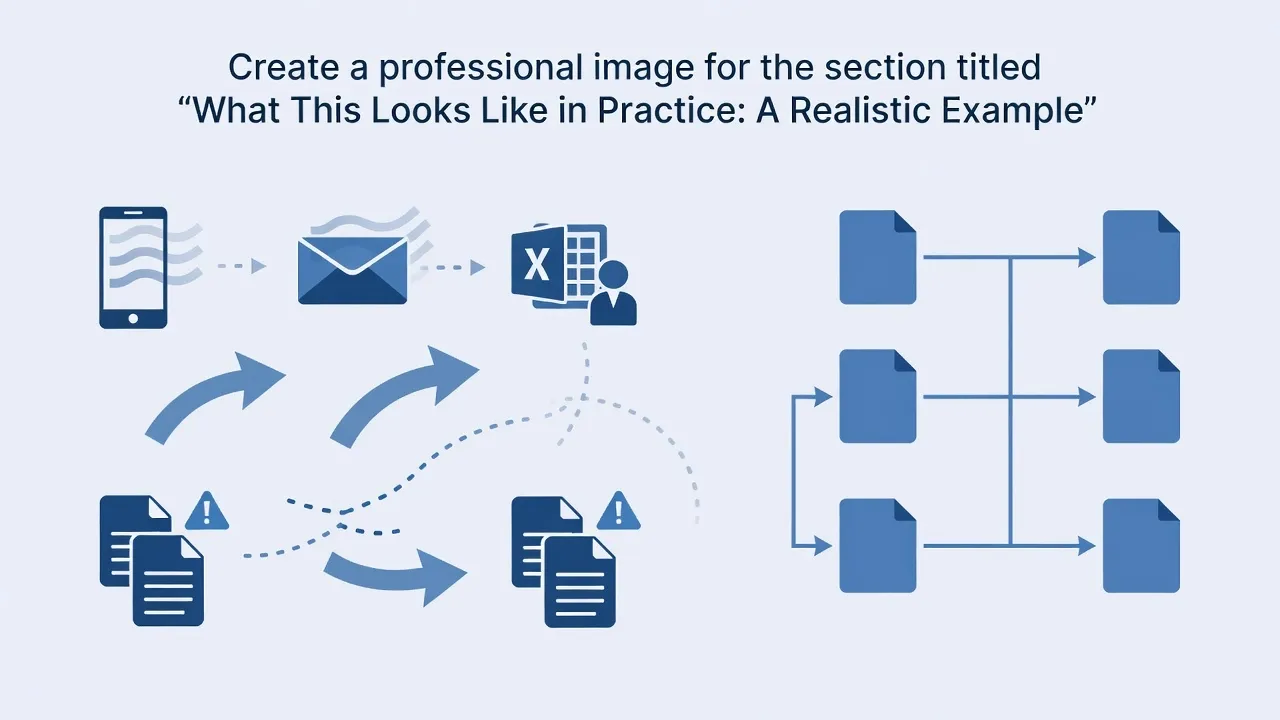
Consider a regional trading business with 45 staff. Purchase orders are managed through a combination of WhatsApp messages, email chains, and a shared Excel file maintained by a single finance executive. Approvals are slow, the audit trail is non-existent, and three near-misses with duplicate orders in the past year have prompted the COO to act.
What Happens Without a Scope
The COO searches the market for a procurement tool. Three proposals arrive, each ranging widely in price. On closer inspection, each vendor has made a different set of assumptions: one has priced a full supplier management module, one has assumed a basic approval workflow, and one has included contract storage and payment processing. The COO cannot evaluate them meaningfully because none of them are proposing to solve the same problem. The process stalls, or worse, a decision is made based on price alone, and the wrong assumptions get built into the system.
What a Structured Scoping Exercise Surfaces
When the team maps the actual workflow, a more precise picture emerges. There are four distinct user types: requestors raising purchase orders, department heads with first-level approval authority, the finance team managing thresholds and exceptions, and the MD requiring a read-only view for oversight. Two separate approval thresholds exist, each with a different escalation path. The existing accounting software must be integrated from day one, an integration that adds more complexity than the visible interface suggests. A regulatory requirement for seven-year document retention applies under applicable commercial record-keeping obligations. The system must also support both English and Arabic document labels, a functional requirement that would not appear in any standard procurement tool brief.
Critically, the scoping exercise also captures what is explicitly out of scope for phase one: vendor management, contract storage, and payment processing. These features were raised in early internal discussions, but the team agreed to defer them. Documenting exclusions is as important as documenting inclusions; without that list, a development partner may assume those features are implied.
The Practical Outcome
The COO can now issue a consistent brief to any development partner. Proposals become directly comparable because every partner is responding to the same defined problem. The build begins with shared understanding of what is being constructed, for whom, and how success will be measured, such as reduction in approval cycle time, elimination of duplicate order incidents, and the ability to produce a complete audit trail on demand. Requirements that would otherwise surface mid-build are already documented, and the scoping process itself functions as the contract that makes cost estimates credible and timelines defensible. None of this required months of preparation; it required deliberate structured conversations before anyone wrote a specification.
Build vs. Buy: Where Scoping Fits the Decision
Most founders approach the build vs. buy question as a strategic decision made before any detailed planning begins. In practice, this sequence produces poor outcomes in both directions. The scoping process is not only useful when you have already decided to build; it is the most reliable mechanism for determining whether you should build at all. Until you have mapped your workflow, identified your users, listed your integrations, and documented what the system must actually do, you do not have enough information to evaluate an off-the-shelf alternative meaningfully. A product comparison made before requirements are defined is not an evaluation. It is a guess shaped by whichever demo you found most persuasive.
When Off-the-Shelf Is the Right Answer
Established SaaS products exist because a large number of businesses share similar operational needs. If your workflow is largely standard, your volumes are modest, and a review of available tools suggests coverage of 80 to 90 percent of your requirements without significant configuration, the cost and time advantage of a proven product is real and should not be dismissed. Vendor-managed maintenance, predictable licensing costs, and rapid deployment are genuine benefits. The right answer is sometimes simply to buy a good product and adopt the workflow it supports, rather than engineering around a preference for how things have always been done internally.
That said, the hidden costs of the buy path are often underestimated at the point of purchase. Integration between multiple purchased products compounds over time into a fragmented data estate. A business that acquires three SaaS subscriptions to cover a single operational process often finds that the tools do not exchange data cleanly, that reconciliation becomes a manual task, and that the total cost of ownership across a three to five year horizon exceeds what a targeted custom build would have required. Research from MadDevs' strategic guide to build vs. buy notes that purchased tools also carry a structural ceiling: competitors can access identical capabilities, meaning an off-the-shelf product cannot itself be a source of differentiation.
When Custom Software Is Justified
Custom development is warranted in four specific situations. First, when your workflow is genuinely differentiated and an off-the-shelf product would require you to change the workflow to fit the tool rather than the other way around. Second, when your integration requirements are complex and available products do not connect reliably to your existing systems. Third, when data ownership, security, or regulatory compliance requirements cannot be satisfied by a cloud-hosted product. Fourth, when the process being automated is a direct source of competitive advantage and the capability must remain proprietary.
The Saigon Technology guide on build vs. buy software decisions reinforces that custom development delivers complete control over roadmap direction, intellectual property ownership, and scalability designed around unique growth patterns that standard tools cannot accommodate. These advantages are real, but they come with a legitimate counterbalance: higher upfront investment, longer delivery timelines, and an ongoing maintenance responsibility that must be planned for.
The Hybrid Option Most Businesses Miss
Between full custom development and a portfolio of disconnected SaaS products sits an option that most founders do not consider, because it only becomes visible after the workflow has been mapped carefully. A custom-built integration layer that connects and orchestrates existing tools can deliver meaningful flexibility at a fraction of a full-build cost. This composable approach treats commodity functions as bought components and builds only the logic that is genuinely specific to the business. The result is a system that behaves like custom software from an operational perspective, without requiring every component to be built from scratch.
Scope First, Then Decide
The practical implication is straightforward. A founder who commits to building before scoping risks discovering mid-project that a suitable product already existed. A founder who dismisses custom software without scoping frequently ends up administering three SaaS subscriptions that generate as much coordination overhead as the spreadsheet they replaced. As the Acceldata build vs. buy guide notes, the decision carries strategic weight across competitive differentiation, resource allocation, and technical debt simultaneously. None of those dimensions can be evaluated honestly without first defining requirements in detail. The sequence is not: decide, then scope. It is: scope, then decide.
How to Prepare for a Scoping Conversation with a Development Partner
The most productive scoping conversation is not the one where you arrive with the longest feature list. It is the one where you arrive with the clearest picture of how your business actually operates today. Before your first meeting with a development partner, write down the current process in plain language. Not what you want the software to do, but what your team does right now, step by step, including the workarounds, the manual handoffs, and the exceptions that happen every week. Even a rough written description of today's reality is more useful than a polished brief about tomorrow's vision, because it gives a development partner something concrete to diagnose rather than a wish list to cost blindly.
Alongside that written description, gather the physical artefacts your current process produces. Bring the spreadsheet you are replacing. Bring the report format your finance team uses each month. Bring the WhatsApp message template your operations staff send to suppliers. These are not supplementary materials; they are primary inputs. A development partner who can see the actual object being replaced will make far fewer assumptions than one working from a verbal description. Assumptions that go unchecked during a scoping conversation reliably surface as expensive misunderstandings during development.
Before the meeting, identify the three internal voices who need to be part of the requirements conversation: the person who owns the process, the people who run it daily, and the person who controls the budget. Each brings a different and necessary perspective. Process owners understand the business logic. Daily users understand the friction. Budget approvers understand the constraints and the strategic priority. A scope built without all three perspectives will have a gap; the only question is where it appears and how much it costs to close.
Prepare a clear answer to one specific question: what does success look like in six months, expressed as operational change rather than features delivered? Not "we want a dashboard," but "our operations manager will no longer spend three hours each Monday reconciling purchase orders manually." That framing shifts the conversation from output to outcome, which is where meaningful scoping begins.
Finally, clarify your data situation before you arrive. Identify what data currently exists, in what format, and whether any of it needs to be migrated into the new system. Data migration is one of the most consistently underestimated sources of project delay, not because it is technically complex in every case, but because its complexity is rarely assessed until development is already underway. Knowing the state of your data in advance, including whether it is clean, structured, and complete, allows a development partner to scope that work accurately from the start rather than discover it mid-build.
Questions to Ask Any Software Development Partner Before You Sign
The quality of your development partner shapes every outcome that follows. Before any contract is signed, six questions will tell you most of what you need to know.
"How do you run your discovery and scoping process, and what does it produce?"
A rigorous partner will describe a structured engagement with named outputs: a documented workflow map, a prioritised feature list, an integration inventory, and a written scope. They will explain how they conduct stakeholder interviews, map existing processes, define user roles, and identify technical constraints before any design or development work begins. A vague answer along the lines of "we'll figure it out together as we go" is not a sign of flexibility; it is a sign that scoping has not been built into their process as a professional discipline. Skipping discovery consistently increases cost later, because unclear requirements create rework, rework creates delays, and delays create budget pressure that the client typically absorbs.
"How do you handle requirements that emerge after scoping is complete?"
The answer to this question reveals whether the partner has a formal change control process or treats scope changes as an informal negotiation. A credible partner will describe a written change request mechanism, an impact assessment step, an approval process, and a contract amendment before additional work begins. The absence of a defined process creates contractual ambiguity and exposes the buyer to uncontrolled cost escalation. Scope creep is not an exceptional event on complex projects; it is a near-universal one, and a partner who has not structured their process around it has not thought through project risk.
"Who will be working on this project, and will I have direct access to them?"
Partners often present senior consultants during the sales process and hand delivery to a different team after signing. Before committing, understand exactly who will be responsible for your project at each phase, what their experience level is, and whether you will have direct working contact with them. Senior oversight throughout the engagement, not just at the proposal stage, is a meaningful quality signal.
"Can you show me documentation from a previous project of similar complexity?"
Ask for actual artefacts, not a polished case study. A scope document structure, a technical specification format, a test plan. Partners who operate rigorously have these documents and can share redacted versions without hesitation. Partners who do not produce structured documentation at each project phase will deflect toward credentials and client logos instead.
"What happens if we are halfway through and requirements turn out to be more complex than scoped?"
The honest answer describes a defined process: a change request conversation, transparent cost implications, and a documented agreement before work continues. A partner who cannot answer this clearly either has not encountered it, which is unlikely, or has not built a structured response into their practice. Mid-project complexity revelations should trigger a conversation, not a surprise invoice.
"What does your quality assurance process look like, and how is it built into the timeline?"
QA bolted on at the end of a project is a risk signal. Defects caught late cost significantly more to resolve than those identified during development, both in rework time and in schedule extension. A mature development organisation integrates QA into each phase rather than treating it as a final review gate. Ask the partner to describe specifically how testing is structured across the project, not just what happens before go-live.
The pattern across all six questions is consistent: you are looking for structure, defined outputs, and transparent processes. Vague answers to any of these questions are informative data points, not minor gaps to overlook before signing.
Common Scoping Mistakes and How to Avoid Them
The most expensive scoping errors are rarely dramatic. They accumulate quietly, through assumptions that go unchallenged, conversations that never happen, and documents that are never written.
Scoping the Solution Instead of the Problem
The most structurally common error is arriving at a scoping conversation with a system in mind rather than a problem to solve. "We need a customer portal" describes an output. "Our support team handles approximately 200 status enquiries per day by phone because customers have no self-service visibility into their order status" describes a problem worth solving. The distinction matters because only the second version allows a development partner to question whether a portal is actually the right solution, or whether a simpler notification mechanism would achieve the same outcome at a fraction of the cost. Briefs that lead with desired systems tend to produce builds that deliver the requested system without resolving the underlying problem.
Treating Undocumented Processes as Documented Ones
In operator-led SMEs, the process described in a job description and the process that actually runs the business are frequently two different things. Real workflows accumulate informal workarounds, personal judgment calls, and coordination that happens through WhatsApp threads or verbal handoffs that no one has ever written down. When a development team scopes against the assumed process rather than the actual one, the gap surfaces mid-build, where it is expensive to address. Before any scoping document is finalised, verify how work actually flows by walking through it with the people doing it, not by reviewing the documentation that describes how it is supposed to work.
Involving Too Few Stakeholders
A scope defined exclusively by leadership tends to capture strategic intent while missing the operational detail that daily users understand. A scope defined exclusively by daily users tends to capture process granularity while missing the reporting, audit, and governance requirements that senior leadership needs. Both sets of requirements belong in the same scope document. Identifying the right stakeholders before requirements gathering begins, rather than discovering missing perspectives during review, is a basic safeguard that is routinely skipped under time pressure.
Leaving Integrations and Data Migration for Later
Integrations and data migration are consistently among the most technically complex and time-consuming elements of any build. Third-party systems have undocumented behaviour. Legacy data contains quality problems and format inconsistencies that only become visible when migration is attempted. External APIs carry rate limits, authentication requirements, and version dependencies that affect architectural decisions made early in the project. Treating these as details to be resolved during build, rather than requirements to be surfaced and scoped upfront, is a reliable path to timeline extension and budget overruns. Every integration in scope should be named, its connection method identified, and its data requirements documented before any cost estimate is accepted.
Accepting a Proposal Without a Written Scope
A cost estimate produced without a detailed scope document is not a quotation; it is a number attached to a set of unstated assumptions. Without a documented scope, there is no shared definition of what is included, what is excluded, what assumptions the estimate rests on, or what constitutes a change request. The conditions for a dispute are built into the engagement from the first invoice. Before making any financial commitment, insist on a written scope document that specifies features, integrations, exclusions, assumptions, and acceptance criteria. The Project Management Institute has identified scope creep as the single most consistent driver of cost overruns in software projects. A written scope is the primary mechanism for preventing it.
A Reusable Scoping Checklist for Your Next Project
Use this checklist before any scoping conversation, and return to it at each milestone to confirm nothing has drifted.
Problem Definition
Can you state the business problem in one or two sentences without mentioning software or technology?
Have you quantified the current pain in terms of time lost, error rate, cost, or operational risk?
Workflow Mapping
Have you documented the current process step by step, including the informal workarounds people actually use?
Have you identified where handoffs fail, where data is lost, and where decisions stall or get made informally?
User Identification
Have you listed every category of user, including approvers, administrators, read-only viewers, and any external parties such as clients, suppliers, or auditors?
Have you documented the specific permissions each user type requires, including who can view, edit, approve, and export?
Feature Prioritisation
Have you separated features required at go-live from features that can be introduced in a later phase?
Have you documented the explicit exclusions agreed for this phase, not just what is included?
Integrations and Data
Have you listed every system the new software must connect to and confirmed whether a documented API exists for each?
Have you assessed the current state, format, volume, and quality of any data to be migrated before committing to a timeline?
Security and Compliance
Have you identified which data is sensitive and documented who can see, edit, or export it?
Have you confirmed any regulatory or jurisdictional requirements that apply to your business, your data, or your industry?
Success Criteria
Have you defined what a successful go-live looks like in measurable, observable terms that all stakeholders have agreed on?
Have you agreed on a formal process for handling requirements that emerge after the scope is finalised, including who approves changes and how impact is assessed?
A scope document that cannot answer every question above is not yet ready to send to a development partner. Each unanswered item is an assumption that will surface later, at greater cost.
Start With Clarity, Not Code
Scoping is not a preliminary formality. It is the most consequential work in any software project, and the decisions made before a single line of code is written determine whether the build delivers genuine operational value or becomes an expensive exercise in managing misaligned expectations. Every framework in this guide, from problem definition and workflow mapping through feature prioritisation, integration planning, security considerations, and success criteria, applies equally whether you are replacing a spreadsheet-driven process, connecting fragmented tools, or turning an early product idea into a realistic MVP.
The discipline holds regardless of project size or sector. A 12-person logistics business replacing a WhatsApp-and-Excel procurement process and a 200-person services firm building a client portal face the same foundational requirement: clarity about the problem before any conversation about the solution.
If you have read this far, you are likely at the stage where you know a process needs to change but are not yet certain what the right solution looks like. That is precisely the right moment for a structured discovery conversation, not a vendor proposal. Arriving with a feature list and requesting quotes before the problem is clearly defined is the single most reliable way to receive estimates that will not hold.
Vagary runs focused technical audits and discovery calls designed to help UAE founders, COOs, and operations leaders turn a business problem into a clear, realistic, and buildable scope. If you would like to explore whether your situation warrants custom software and what a scoped engagement would look like, we would be glad to talk.
Conclusion
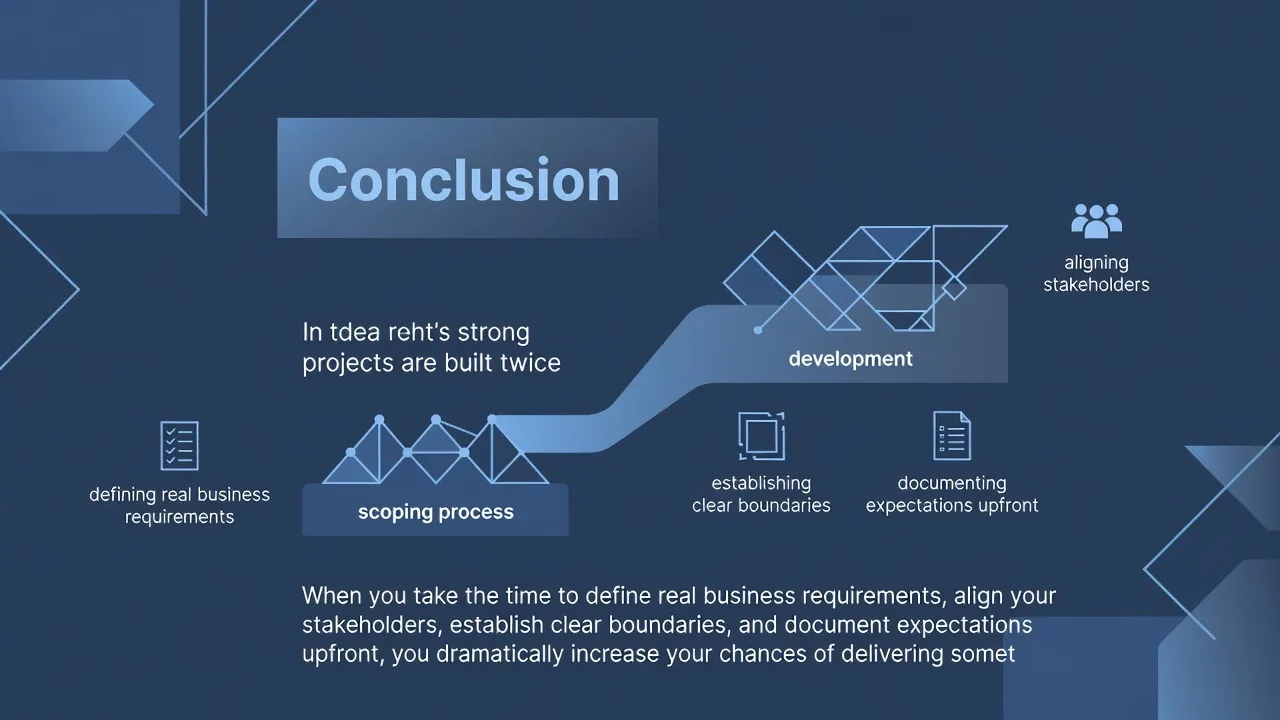
Strong software projects are built twice: first in the scoping process, then in development. When you take the time to define real business requirements, align your stakeholders, establish clear boundaries, and document expectations upfront, you dramatically increase your chances of delivering something that actually works.
The core takeaways are simple. Vague requirements create expensive problems. Stakeholder alignment prevents costly surprises. Clear boundaries protect your budget and timeline. And thorough documentation keeps everyone accountable from start to finish.
Now it is time to put this framework into action. Before your next project kicks off, schedule a dedicated scoping session with your key decision-makers. Use the principles in this guide to drive that conversation.
The difference between a project that transforms your business and one that drains it often comes down to the work you do before any code is written. Start there.